Cheapest Health Insurance Plans by State: 2026 Guide
Cheapest Health Insurance Plans by State 2026
Compare the cheapest health insurance options by state in 2026, including Marketplace plans, subsidies, benchmark premiums, and ways to lower your costs.
cheapest-health-insurance-plans-by-state
Health insurance can feel surprisingly expensive, especially when you are shopping on your own. A plan that looks affordable in one state may cost much more in another, and the lowest monthly premium is not always the cheapest option once deductibles, copays, prescriptions, and doctor visits are included.
The good news is that you do not necessarily have to choose between expensive coverage and going uninsured. For 2026, Marketplace shoppers may qualify for premium tax credits or other savings depending on their circumstances. HealthCare.gov also allows consumers to preview available plans and estimated prices before applying.
In this guide, you will learn which states have the lowest average benchmark Marketplace premiums, how subsidies can change what you actually pay, which plan types are usually worth comparing, and how to find affordable coverage without sacrificing important benefits.
What Are the Cheapest Health Insurance Plans by State?
The cheapest health insurance plan by state is the lowest-cost plan available to an individual, based on their location, age, household income, family size, plan benefits, and eligibility for financial assistance. Because Marketplace prices vary by ZIP code and personal circumstances, there is no single cheapest plan that applies to everyone in a state.
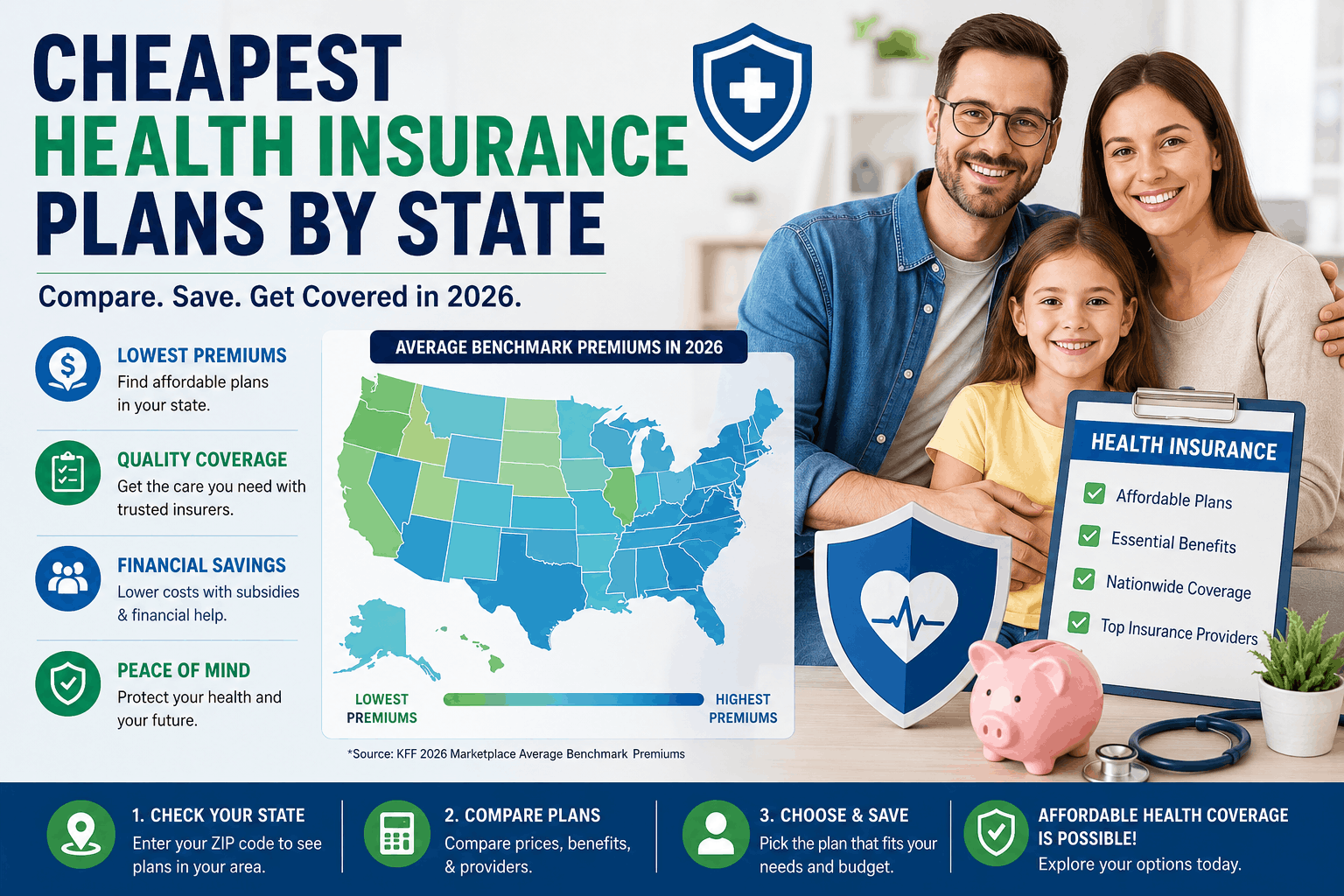
For comparison, KFF’s 2026 data show that the national average benchmark premium for a 40-year-old is $625 per month before premium tax credits are applied. Some states have substantially lower benchmark premiums, while others are considerably higher.
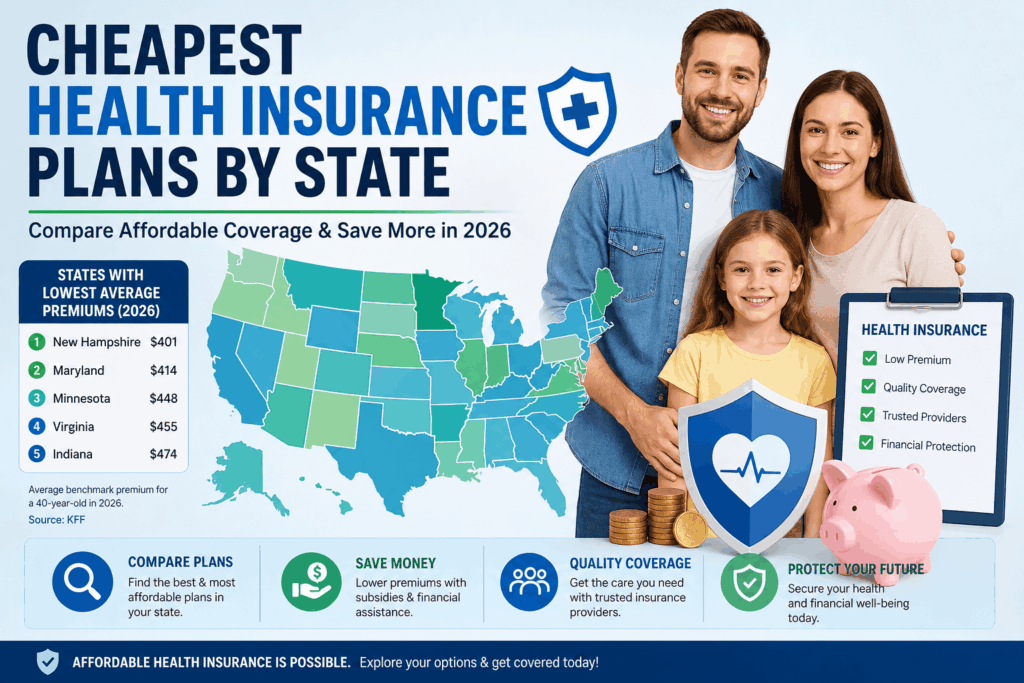
States With the Lowest Average Benchmark Premiums in 2026
The following figures provide a useful starting point for comparing states. They represent average benchmark premiums, not guaranteed prices for a specific person.
| New Hampshire | $401/month |
| Maryland | $414/month |
| Minnesota | $448/month |
| Virginia | $455/month |
| Indiana | $474/month |
| Massachusetts | $494/month |
| Nevada | $497/month |
| Iowa | $501/month |
| Rhode Island | $506/month |
| Ohio | $513/month |
| Michigan | $523/month |
| Arizona | $532/month |
| Hawaii | $541/month |
| Oregon | $543/month |
| New Jersey | $545/month |
KFF calculates these benchmark premiums using the second-lowest-cost Silver plan for a 40-year-old and weights the results by county. They are useful for understanding differences between states, but they should not be interpreted as quotes for every consumer.
At the other end of the range, Vermont, Wyoming, and West Virginia have among the highest average benchmark premiums for 2026. KFF reports average benchmark premiums of $1,299, $1,090, and $1,073 per month, respectively.
2026 Average Benchmark Premiums by State
For readers who want a broader state-by-state comparison, the table below lists KFF’s 2026 average benchmark premium data.
| State | Average Benchmark Premium |
| Alabama | $645 |
| Alaska | $1,032 |
| Arizona | $532 |
| Arkansas | $774 |
| California | $570 |
| Colorado | $557 |
| Connecticut | $870 |
| Delaware | $691 |
| Florida | $683 |
| Georgia | $615 |
| Hawaii | $541 |
| Idaho | $490 |
| Illinois | $646 |
| Indiana | $474 |
| Iowa | $501 |
| Kansas | $670 |
| Kentucky | $590 |
| Louisiana | $646 |
| Maine | $709 |
| Maryland | $414 |
| Massachusetts | $494 |
| Michigan | $523 |
| Minnesota | $448 |
| Mississippi | $662 |
| Missouri | $605 |
| Montana | $692 |
| Nebraska | $710 |
| Nevada | $497 |
| New Hampshire | $401 |
| New Jersey | $545 |
| New Mexico | $623 |
| New York | $817 |
| North Carolina | $638 |
| North Dakota | $570 |
| Ohio | $513 |
| Oklahoma | $604 |
| Oregon | $543 |
| Pennsylvania | $572 |
| Rhode Island | $506 |
| South Carolina | $564 |
| South Dakota | $655 |
| Tennessee | $711 |
| Texas | $661 |
| Utah | $640 |
| Vermont | $1,299 |
| Virginia | $455 |
| Washington | $612 |
| West Virginia | $1,073 |
| Wisconsin | $611 |
| Wyoming | $1,090 |
These figures are based on KFF analysis of Marketplace and state insurance data. The District of Columbia, which is not a state, had an average benchmark premium of $610.
Why the Cheapest Plan Is Not Always the Best Plan
It is tempting to choose the plan with the smallest monthly premium. However, that approach can become expensive if you need regular healthcare.
For example, imagine two plans:
- Plan A costs $250 per month but has a $7,500 deductible.
- Plan B costs $330 per month but has a $3,500 deductible and lower copays.
Plan A saves $80 each month in premiums. But if you regularly see doctors, take prescriptions, or expect medical treatment, Plan B could potentially cost less overall.
This is why you should compare total expected healthcare costs, not just the premium.
Look at:
- Monthly premium
- Annual deductible
- Copays
- Coinsurance
- Out-of-pocket maximum
- Prescription coverage
- Doctor and hospital networks
- Covered services
- Whether your preferred providers are in-network
How Marketplace Subsidies Can Make Health Insurance Cheaper
The price shown before financial assistance may look very different from the amount you ultimately pay.
Eligible Marketplace consumers may receive an advance premium tax credit that reduces their monthly premium. HealthCare.gov notes that prices shown before applying for coverage do not reflect all savings a person may qualify for based on household income and size.
For 2026, CMS projected that the average premium for the lowest-cost plan on HealthCare.gov would be about $50 per month after tax credits for eligible enrollees. This is an average projection, not a guarantee that every eligible person will receive a plan at that price.
Your actual price can depend on factors such as:
- Household income
- Household size
- Age
- Location
- Plan selection
- Eligibility for financial assistance
Because circumstances can change, it is important to provide accurate information when applying and update your Marketplace application if your income or household situation changes. HealthCare.gov warns that receiving more advance premium tax credit than you qualify for can affect your federal tax return.
Which Health Insurance Plan Type Is Usually Cheapest?
Bronze Plans
Bronze plans generally have lower monthly premiums but higher costs when you use healthcare. They may make sense for people who mainly want protection from large medical bills and do not expect frequent healthcare use.
A low premium does not mean low total costs, however. Always check the deductible and out-of-pocket maximum.
Silver Plans
Silver plans typically sit between Bronze and Gold in terms of premiums and cost-sharing.
They are particularly important to compare because the benchmark plan used for Marketplace premium comparisons is a Silver plan. Depending on eligibility, financial assistance can also affect the affordability of Silver coverage.
Gold Plans
Gold plans generally have higher monthly premiums but lower cost-sharing when you receive covered care.
Someone who expects frequent doctor visits, regular prescriptions, or ongoing treatment may find that a higher-premium plan fits their budget better overall.
Catastrophic Plans
Catastrophic coverage is designed for certain eligible consumers and generally combines a low premium with a high deductible. Eligibility rules apply, so it is not an option for everyone.
For 2026, CMS says Bronze and catastrophic Marketplace plans are HSA-eligible in states using HealthCare.gov, expanding access to HSA-eligible coverage.
How to Find the Cheapest Health Insurance in Your State
Start by checking your Marketplace options rather than relying on a generic national price.
HealthCare.gov allows consumers to enter their ZIP code and review estimated 2026 plans and prices before completing an application. Final pricing is provided after the Marketplace evaluates the application.
If your state operates its own Marketplace, you may be directed to the state’s enrollment platform.
Then compare at least three plans. Do not automatically choose the first plan with a low premium.
For each plan, check the deductible, out-of-pocket maximum, provider network, prescription coverage, and expected healthcare needs.
What Makes Health Insurance Affordable?
Affordability is different for every household.
A healthy single adult may prioritize a low premium and a large provider network. A family with children may care more about pediatric providers, prescription costs, and predictable copays.
A self-employed worker may focus heavily on monthly premiums and tax considerations, while someone who expects surgery or frequent specialist visits may prioritize lower out-of-pocket costs.
The cheapest plan is therefore the one that provides the protection you need at a total cost you can realistically manage.
Comparison Table
| What to Compare | Lower-Cost Option | Potential Trade-Off |
| Premium | Usually lower | You may pay more when receiving care |
| Deductible | Usually higher | More upfront spending before coverage pays |
| Copays | May be higher | More cost per visit or prescription |
| Coinsurance | Can be higher | Greater share of certain medical costs |
| Provider network | May be narrower | Fewer doctors or hospitals available |
| Out-of-pocket maximum | Can be higher | Greater financial exposure in a serious illness |
| Bronze plan | Lower premium | Higher cost-sharing |
| Silver plan | Moderate premium | May cost more monthly but can provide balanced coverage |
| Gold plan | Higher premium | Often lower cost-sharing |
Practical Tips
Compare Plans Using Your ZIP Code
Health insurance pricing is location-specific. A state average can help you understand the market, but your ZIP code provides a much more useful starting point.
Check Your Subsidy Eligibility
Do not assume you have to pay the full advertised premium. Complete the Marketplace application to determine whether you qualify for financial assistance.
Look Beyond the Premium
A $50 monthly difference may not matter if the cheaper plan has thousands of dollars more in potential out-of-pocket costs.
Check Your Doctors Before Enrolling
If you already have a primary-care doctor, specialist, or preferred hospital, verify that they participate in the plan’s network.
Review Prescription Coverage
If you take regular medication, check the plan’s drug formulary and cost-sharing rules before choosing coverage.
Compare Every Year
Your existing plan may not remain your best option. Premiums, benefits, networks, and available plans can change from year to year.
Common Mistakes
Choosing the Lowest Premium Automatically
The lowest monthly payment can come with a high deductible and significant cost-sharing.
Ignoring the Out-of-Pocket Maximum
This figure can be more important than the premium if you experience a major medical event.
Assuming All Doctors Accept the Same Plans
Provider networks vary between insurers and individual plans. Confirm network participation before enrolling.
Forgetting About Financial Assistance
Looking only at the full premium can make Marketplace coverage appear more expensive than it may actually be for an eligible household.
Using Old Pricing Information
Health insurance prices change. For 2026 coverage, use current Marketplace information rather than relying on old articles or previous-year quotes.
Buying a Plan Without Checking the Details
A low-cost plan is not useful if it does not cover the services, prescriptions, or providers you need.
Key Takeaways
- Health insurance prices vary significantly by state and ZIP code.
- The cheapest health insurance plan for one person may not be the cheapest for another.
- KFF’s 2026 data places New Hampshire, Maryland, Minnesota, Virginia, and Indiana among the states with the lowest average benchmark premiums.
- Benchmark premiums are comparison figures, not guaranteed quotes.
- Premium tax credits can substantially reduce Marketplace premiums for eligible consumers.
- Compare deductibles, copays, coinsurance, networks, prescriptions, and out-of-pocket maximums before enrolling.
- HealthCare.gov lets consumers preview 2026 plans and estimated prices before applying.
- The right plan is usually the one that balances monthly premiums with the healthcare costs you are most likely to face.
Frequently Asked Questions
What is the cheapest state for health insurance in 2026?
Based on KFF’s 2026 average benchmark premium data, New Hampshire has the lowest average benchmark premium at $401 per month for the comparison scenario used by KFF. This does not mean every resident of New Hampshire will receive a $401 premium or that it will be the cheapest available plan for every individual.
What is the cheapest health insurance plan in the United States?
There is no single cheapest health insurance plan for everyone. Prices depend on location, age, household circumstances, income, plan design, and eligibility for financial assistance. The cheapest plan for one person may have very different costs for another.
Can I get health insurance for less than $100 a month?
Some eligible Marketplace consumers may qualify for substantial premium tax credits that reduce their monthly premium. CMS projected an average after-tax-credit premium of $50 per month for the lowest-cost HealthCare.gov plan in 2026 among eligible enrollees. Individual prices can be higher or lower.

Is a Bronze plan the cheapest option?
Bronze plans generally have lower monthly premiums than higher metal-tier plans, but they can have higher deductibles and other out-of-pocket costs. If you use healthcare frequently, another plan may provide better overall value.
How can I find the cheapest health insurance in my state?
Enter your ZIP code on the appropriate Marketplace website, check available financial assistance, and compare several plans. Look at the total potential cost rather than focusing only on the monthly premium. HealthCare.gov provides a tool for previewing 2026 plans and estimated prices.
Are health insurance prices the same throughout a state?
No. Marketplace premiums can vary by geographic rating area and other factors. KFF’s state averages combine county-level information, so they should be viewed as broad comparisons rather than individual quotes.
Should I choose the cheapest health insurance plan?
Not necessarily. A low premium can be attractive, but a plan with a higher deductible, narrower network, or greater cost-sharing may cost more when you actually need medical care. Compare the full plan design before making a decision.
Conclusion
Finding the cheapest health insurance plans by state starts with understanding one important point: the cheapest advertised premium is not always the cheapest coverage.
In 2026, Marketplace prices vary considerably across the country. KFF data shows large differences in average benchmark premiums between states, while CMS and HealthCare.gov emphasize that eligible consumers may receive financial assistance that changes the amount they actually pay.
Instead of choosing a plan based only on its monthly premium, compare the deductible, copays, coinsurance, provider network, prescription coverage, and out-of-pocket maximum. Then check whether you qualify for financial assistance.
A few minutes spent comparing the full cost of several plans can help you avoid choosing coverage that looks cheap at first but becomes expensive when you need it.
Disclaimer
This article is published solely for educational and informational purposes. The information provided is intended to increase general awareness and understanding of the topic. It should not be considered medical, insurance, financial, legal, or professional advice. Readers should consult qualified professionals before making any healthcare, insurance, financial, or legal decisions.
References
- Centers for Medicare & Medicaid Services (CMS)
- HealthCare.gov
- KFF
- U.S. Department of Health & Human Services (HHS)
- Internal Revenue Service (IRS)